Women in AI Statistics (2025–2026)
April 6th, 2026
Responsible AI Use Disclaimer: The tools listed are for informational purposes. Users are responsible for adhering to ethical guidelines. Learn more.
 By Kevin Pocock
India’s AI startup ecosystem has reached an inflection point. The country now ranks 3rd globally in AI competitiveness, behind only the US and China, with its AI vibrancy score nearly doubling from 12.9 to 21.6 between 2018 and 2024. The number of GenAI startups tripled in a single year — from roughly 240 in H1 2024 to over 890 in H1 2025.
Cumulatively, more than 170 AI startups and 1,505 AI companies (founded 2018–2025) have raised over $4.45 billion across 971 funding rounds. India’s AI market is projected to reach $126 billion by 2030, with a potential GDP impact of $1.7 trillion by 2035.
The government’s INR 10,371 crore ($1.25 billion) IndiaAI Mission, the India AI Impact Summit 2026 hosted in New Delhi, and fresh capital commitments including a dedicated $1 billion AI fund from the India Deep Tech Alliance are accelerating this momentum.
India is the world’s third-largest startup ecosystem with 200,000+ DPIIT-registered startups and 125+ unicorns. Within this, AI has become one of the fastest-growing segments:
India’s AI market was valued at approximately $6.1 billion in 2023 and is expected to have crossed $8 billion by 2025. According to the Google–Inc42 Bharat AI Startups Report 2026, the market could reach $126 billion by 2030. The enterprise-focused agentic AI market alone generated $132.6 million in revenue in 2024 and is projected to grow to about $1.73 billion by 2030.
AI startup funding in India has seen significant year-over-year growth, though it remains a fraction of US levels:

| Year | AI Startup Funding | Notable Trend |
| 2023 | ~$606M (cumulative GenAI) | Early GenAI traction |
| 2024 | ~$780.5M | 39.9% YoY increase |
| 2025 | $887M–$1.5B (varies by source) | 58% YoY increase per IDTA; 188 deals |
The India Deep Tech Alliance (IDTA) report found AI funding rose 58% YoY in 2025, with 188 deals totaling $1.22 billion. Forbes India tracked $887 million across the 2018–2026 period for 2025 specifically. AI’s share of total VC funding in India rose from ~4.5% in 2020 to ~12.3% in 2025.
Investors are prioritizing application-layer businesses over capital-intensive model development. In 2025, early-stage AI funding totaled $273.3 million, while late-stage rounds raised $260 million. Cumulative GenAI funding rose from $606 million (H1 2023) to $990 million (H1 2025).
Despite progress, India’s AI funding is modest compared to the US ($121 billion in 2025, a 141% jump) and China (~$10 billion). India’s strength lies less in foundation-model development and more in downstream applications where cost-efficient tools solve local challenges.
Founded by Ola’s Bhavish Aggarwal in 2022, Krutrim became India’s fastest company to achieve unicorn status in January 2024, reaching a $1 billion valuation with its inaugural $50 million round led by Matrix Partners India. Key developments:
Founded by Vivek Raghavan and Pratyush Kumar, Sarvam AI has raised $41 million from Lightspeed Venture Partners, Peak XV Partners, and Khosla Ventures. In April 2025, the government selected Sarvam AI to build India’s first sovereign LLM under the IndiaAI Mission.
In February 2026, Sarvam launched five new open-source models including 30B and 105B parameter variants, along with text-to-speech, speech-to-text, and vision models — all trained from scratch on trillions of tokens spanning multiple Indian languages.
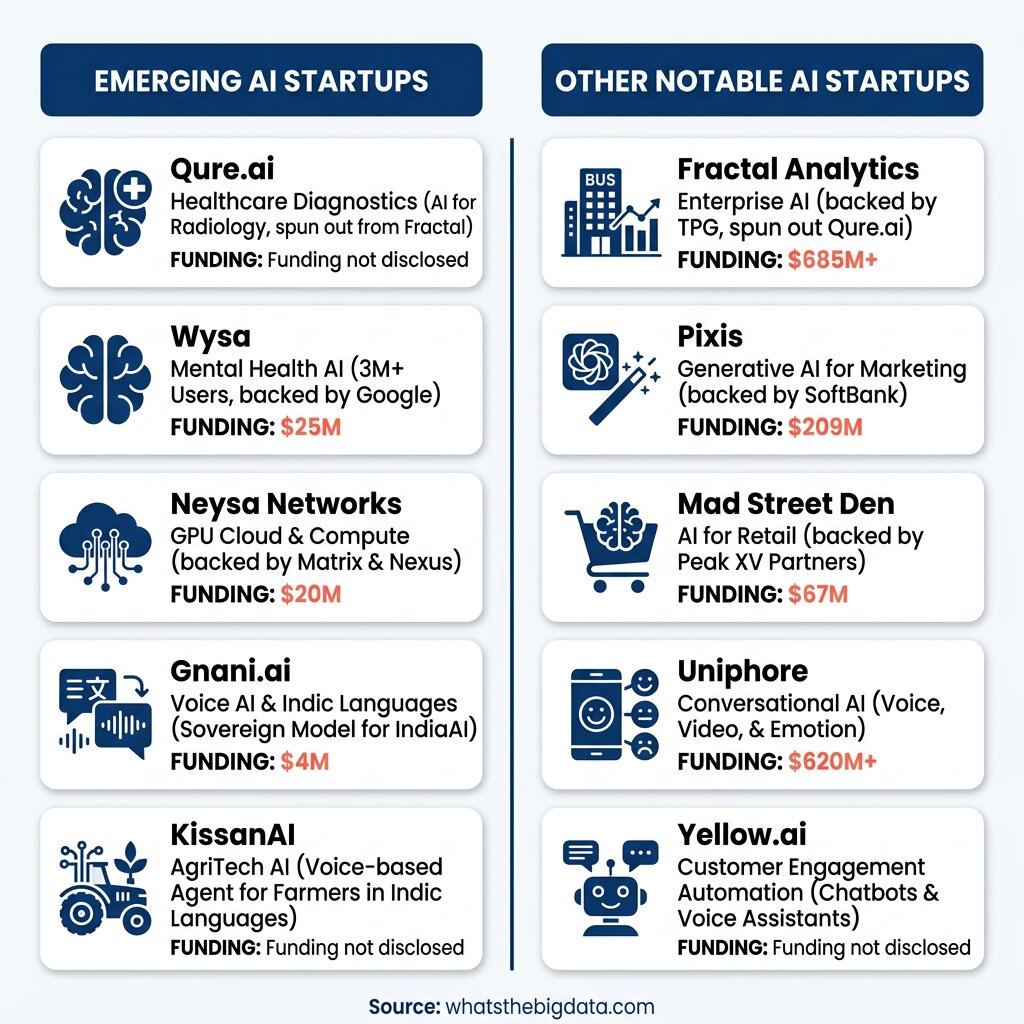
| Startup | Focus Area | Funding | Key Investors / Notes |
| Fractal Analytics | Enterprise AI / Fortune 500 | $685M+ | TPG; spun out Qure.ai; launched Vaidya 2.0 for healthcare AI |
| Pixis | Generative AI for marketing | $209M | SoftBank, General Atlantic, Chiratae Ventures |
| Mad Street Den | AI for retail | $67M | Peak XV Partners, Alpha Wave Global |
| Uniphore | Conversational AI | $620M+ | Chennai-based; voice, video, emotion AI |
| Yellow.ai | Customer engagement automation | — | Bengaluru-based; AI chatbots and voice assistants |
| Qure.ai | Healthcare diagnostics | — | AI for radiology; spun out from Fractal |
| Wysa | Mental health AI | $25M | 3M+ global users; backed by HealthQuad, Google |
| Neysa Networks | GPU cloud / compute | $20M | Matrix Partners, Nexus Venture Partners |
| Gnani.ai | Voice AI / Indic languages | $4M | Selected under IndiaAI Mission for sovereign mode |
| KissanAI | AgriTech AI | — | AI agent for farmers with voice-based Indic support |
India’s AI startups span a wide range of verticals, with particular strength in enterprise AI, healthcare, fintech, and agriculture.
Startups like Krutrim, Sarvam AI, Two AI, and Bharatgen are building foundation models, while Neysa Networks and Agrani Labs are tackling compute infrastructure — building GPU cloud for enterprises and Nvidia alternatives respectively.
Healthcare AI is one of India’s strongest sectors, projected to grow at a 27.6% CAGR, reaching $12.43 billion by 2033. Qure.ai leads in radiology and diagnostics, while Fractal’s Vaidya 2.0 has outperformed leading frontier models on medical reasoning benchmarks. Wysa has become a global AI mental health companion with over 3 million users.
Startups like OnFinance AI (compliance OS for financial services), Moneyview (AI-driven digital lending, recently became unicorn), and Alltius (AI assistants for BFSI) are transforming financial services. GreyLabs AI provides agentic voice AI specifically for India’s BFSI sector.
India’s linguistic diversity has spawned a vibrant voice AI segment. Nurix AI, Smallest, and Gnani.ai focus on enterprise voice solutions optimized for Indic languages. Sarvam AI’s newly released text-to-speech and speech-to-text models further strengthen this category.
KissanAI and Krishi Sathi are building conversational AI for farmers — providing crop advisory, weather insights, and market pricing in local languages.
LexLegis AI, SpotDraft, and Lucio are applying AI to legal workflows, while Dashverse AI and Gan.ai are building AI-native content creation and personalized video generation.
The Cabinet-approved IndiaAI Mission (March 2024) is the backbone of India’s AI policy push. It operates across seven pillars:
Budget allocations surged from INR 173 crore (FY25 revised) to INR 2,000 crore (FY26 budget), a tenfold jump.
Held at Bharat Mandapam, New Delhi from 16–21 February 2026, this was the first AI Summit held in the Global South. Key outcomes include:
India has adopted a balanced, pro-innovation approach: governing AI applications through sectoral regulators rather than regulating the underlying technology itself. The government has also announced a tax holiday until 2047 for companies building data centre infrastructure in India.
Despite $20 billion in AI commitments, access to compute power remains one of the biggest barriers for early-stage AI startups. High GPU costs and complex infrastructure limit smaller innovators, making computing access feel like “an exclusive privilege rather than a public utility”.
Indian AI startups raised roughly $1.2 billion in 2025 versus over $121 billion in the US — a 100x gap. Only 16% of startups reported access to next-level funding, with most being self-funded or angel-backed. Many startups get trapped in “PoC purgatory” — months of pilots with no contracts.
India has 2.5x the global average concentration of AI-skilled professionals, but persistent talent flight continues due to limited high-end domestic opportunities and a lack of competitive policy incentives. Gaps remain in product leadership, deployment, and go-to-market execution rather than raw engineering capability.
Only 23% of Indian enterprises have fully integrated AI into their strategy, and just 10% of startups invested more than INR 1 crore in AI in 2025. Moving from pilot to production remains the critical bottleneck, though 47% of enterprises are now transitioning pilots into production.
The CCI flagged that established entities own vast high-quality datasets that are not accessible to smaller firms, recommending removal of these barriers to create a level playing field. The IndiaAI Datasets Platform (AIKosh) is working to address this but access remains uneven.
India’s AI startup ecosystem is positioned for significant acceleration through 2026–2030, driven by multiple converging tailwinds:
The key metric to watch is whether India can produce an AI-first company generating $40–$50 million or more in annual revenue — a milestone that has not yet been achieved but is emerging as the ecosystem matures.
Last updated on April 6th, 2026.
More from Statistics


