The internet has become an essential part of everyday life, connecting billions of people worldwide. People use the internet for various activities, including social media, online banking, digital payments, shopping, communication, and entertainment. It also provides access to information, education, and services across different countries.
According to the latest data from the International Telecommunication Union (ITU), approximately 6.3 billion people worldwide are using the internet in 2026. This represents 76% of the global population.
In this article, we explore the latest internet usage statistics for 2026, including the number of internet users worldwide, adoption rates, and differences in internet access across countries and income groups.
Key Internet Usage Statistics
- There are 6.3 billion people using the Internet worldwide in 2026.
- Around 76% of the global population is connected to the Internet.
- Approximately 2 billion people remain offline worldwide.
- Global Internet users increased from 6.1 billion in 2025 to 6.3 billion in 2026.
- Internet usage reaches 93% in high-income countries, compared with 32% in low-income countries.
- The Average time spent by an internet user globally is 6 hours and 35 minutes daily.
- More than 60% of the internet traffic comes from mobile devices.
- Eastern Asia is the leading region with the highest percentage of internet users worldwide.
- Users aged 25 to 34 years old have the highest percentage of internet usage 35.6%.
- Out of 5.44 billion internet users, 5.07 billion users access social media.
- China is the leading country with the highest number of internet users 1.05 billion worldwide.
How Many People Use the Internet in 2026?
As of November 2026, approximately 6.3 billion people worldwide use the internet, representing 76% of the global population, according to the International Telecommunication Union (ITU). This means nearly three out of every four people worldwide have access to the internet.
Global Internet Users Growth
Global Internet usage continued to grow in 2026, with 6.3 billion people worldwide using the Internet, accounting for 76% of the global population. This represents an increase from 6.1 billion users in 2025, when 74% of people had Internet access.
The number of Internet users grew by approximately 200 million in just one year. However, around 2 billion people worldwide remained offline in 2026, showing that Internet access is still not available to everyone.
| Particulars | Internet Usage (2026) | Internet Usage (2025) |
| Global Internet Users | 6.3 billion | 6.1 billion |
| Global Population Using the Internet | 76% | 74% |
Source: International Telecommunication Union (ITU)
Internet Usage by Country Income Group
Internet usage differs widely across countries, depending on income levels and access to digital services. According to the International Telecommunication Union (ITU), 93% of people in high-income countries used the Internet in 2026. In comparison, Internet usage stood at just 32% in low-income countries.
This creates a gap of 61 percentage points between the two income groups. High Internet costs, limited network coverage, and poor infrastructure continue to restrict access in low-income countries. As a result, millions of people still lack access to online information, education, and other digital services.
| Country Income Group | Internet Users |
| High-income countries | 93% |
| Low-income countries | 32% |
Internet Usage by Region Worldwide
Internet usage varies significantly across regions, with Europe and North America recording some of the highest adoption rates in October 2025. According to DataReportal, Northern Europe had the highest Internet usage rate at 97.7%, followed by Western Europe at 95.1% and Northern America at 93.3%.
Eastern Europe and Southern Europe also recorded high rates of 92.7% and 91.6%, respectively. In contrast, Eastern Africa had the lowest Internet usage at 26%, followed by Middle Africa at 33.5% and Western Africa at 42.9%. The global average stood at 73.2%, highlighting the significant differences in Internet access across regions.
| Region | Internet Usage (October 2025) |
| Northern America | 93.3% |
| Central America | 80.0% |
| Caribbean | 71.0% |
| Southern America | 83.8% |
| Northern Europe | 97.7% |
| Western Europe | 95.1% |
| Eastern Europe | 92.7% |
| Southern Europe | 91.6% |
| Northern Africa | 73.5% |
| Western Africa | 42.9% |
| Middle Africa | 33.5% |
| Eastern Africa | 26.0% |
| Southern Africa | 77.6% |
| Central Asia | 82.0% |
| Western Asia | 76.1% |
| Southern Asia | 64.3% |
| Eastern Asia | 90.1% |
| South-Eastern Asia | 82.9% |
| Oceania | 77.5% |
| Global Average | 73.2% |
Source: DataReportal
Internet Usage Statistics by Country
China is the leading country with the highest number of internet users worldwide at 1.05 billion.
Followed by India in the second position with 692 million internet users, and the United States in the third position with 311.3 million internet users.
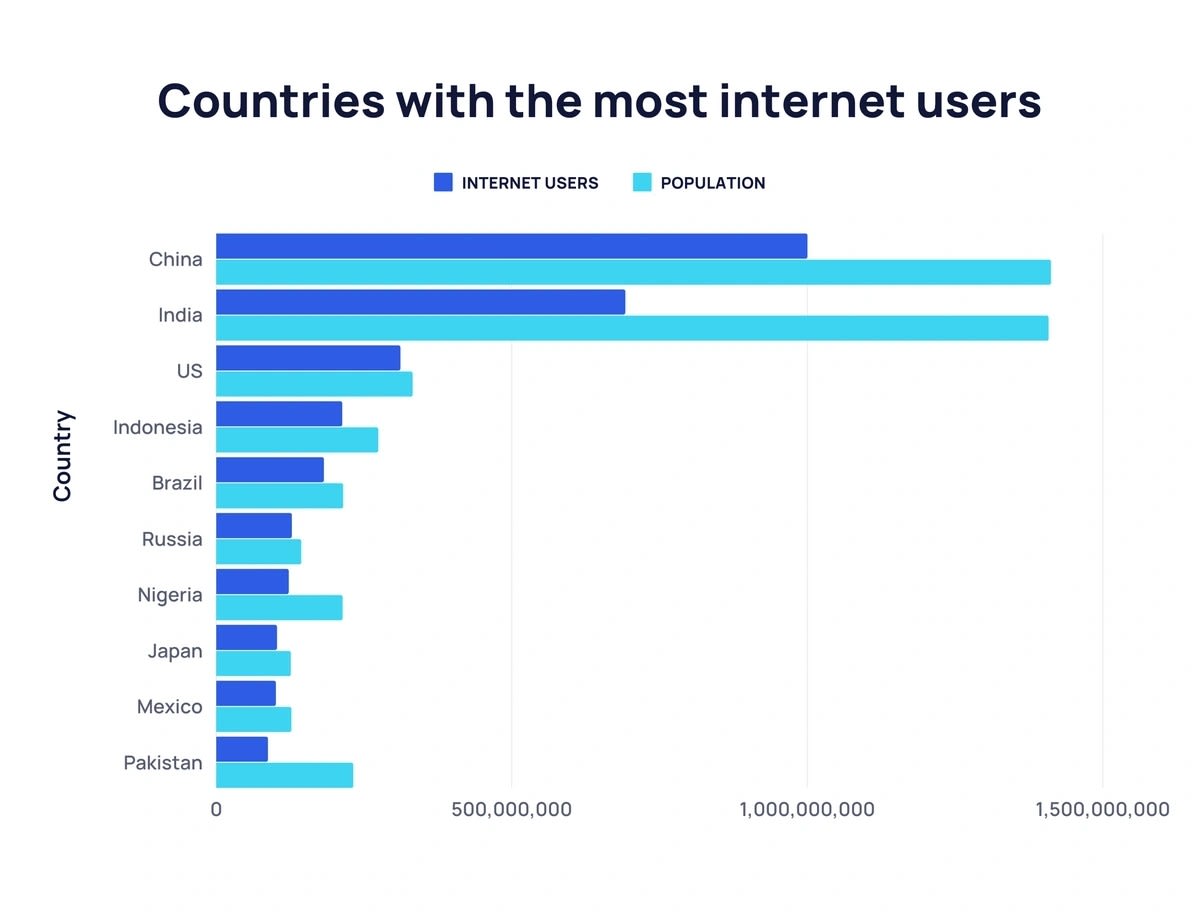
Below we have mentioned a table highlighting the top internet users by country:
| Country | Number of Internet Users |
| China | 1.05 billion |
| India | 692 million |
| US | 311.3 million |
| Indonesia | 212.9 million |
| Brazil | 181.8 million |
| Russia | 127.6 million |
| Nigeria | 122.5 million |
| Japan | 102.5 million |
| Mexico | 100.6 million |
| Pakistan | 87.35 million |
| Philippines | 85.16 million |
| Egypt | 80.75 million |
| Vietnam | 77.93 million |
| Germany | 77.53 million |
| Turkey | 71.38 million |
| Iran | 69.83 million |
| Bangladesh | 66.94 million |
| UK | 66.11 million |
| Thailand | 61.21 million |
| France | 59.94 million |
| Italy | 50.78 million |
| South Korea | 50.56 million |
| Spain | 45.12 million |
| Argentina | 39.79 million |
Source: Statista
Global internet user penetration
As of April 2024, 67.1% of the global population was accessing the internet. Over the years, there has been significant growth in the number of users accessing the internet. Back in 2014, only 35% of the global population was accessing the internet.

Below we have mentioned a table showcasing the share of the global population using the Internet from 2014 to 2024:
| Year | Share of the global population |
| 2014 | 35% |
| 2015 | 42% |
| 2016 | 46% |
| 2017 | 50% |
| 2018 | 53% |
| 2019 | 57% |
| 2020 | 59% |
| 2021 | 59.5% |
| 2022 | 62.5% |
| July 2023 | 64.5% |
| October 2023 | 65.7% |
| January 2024 | 66.2% |
| April 2024 | 67.1% |
Source: Statista
Average Daily Time spent using the Internet
As of the fourth quarter of 2023, the average daily time spent by users accessing the internet was 6 hours and 35 minutes. There has been a decrease of 1% compared to the previous quarter which has a daily average of 6 hours and forty minutes.
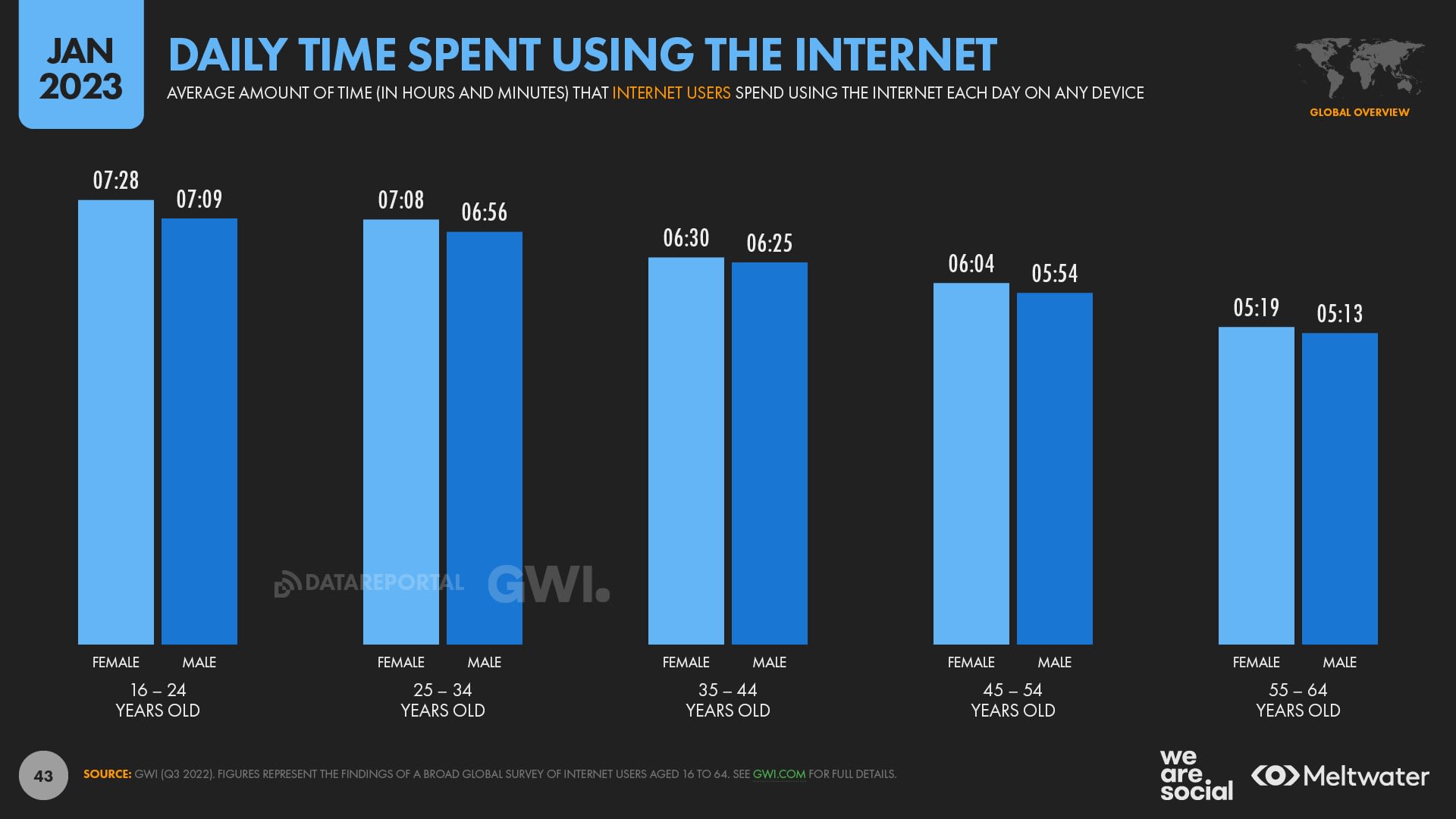
Below we have mentioned a detailed table showcasing the average daily time spent by users accessing the internet:
| Year | Average daily time spent (in hours and minutes) |
| Q3 2015 | 6.19 |
| Q3 2016 | 6.29 |
| Q3 2017 | 6.46 |
| Q3 2018 | 6.48 |
| Q3 2019 | 6.38 |
| Q3 2020 | 6.55 |
| Q3 2021 | 6.57 |
| Q3 2022 | 6.37 |
| Q4 2022 | 6.35 |
| Q1 2023 | 6.4 |
| Q2 2023 | 6.41 |
| Q3 2023 | 6.4 |
| Q4 2023 | 6.35 |
Source: Statista
Internet Penetration Rate by Gender
According to reports by April 2023, the share of women accessing the internet globally is low in comparison to men. The latest data revealed that 64.4% of women worldwide were accessing the internet, while the share of men was 69.8%.

| Gender | Share of users |
| Male | 69.8% |
| Female | 64.4% |
Source: Statista
Internet Usage Statistics by Age
As of February 2024, 35.6% of total internet usage individuals globally were between 25 to 34 years old. Followed by individuals between the ages 35 to 44 as the second leading age group with 24% and young adults aged between 18 to 24 in the third position with 19% of the total internet usage.
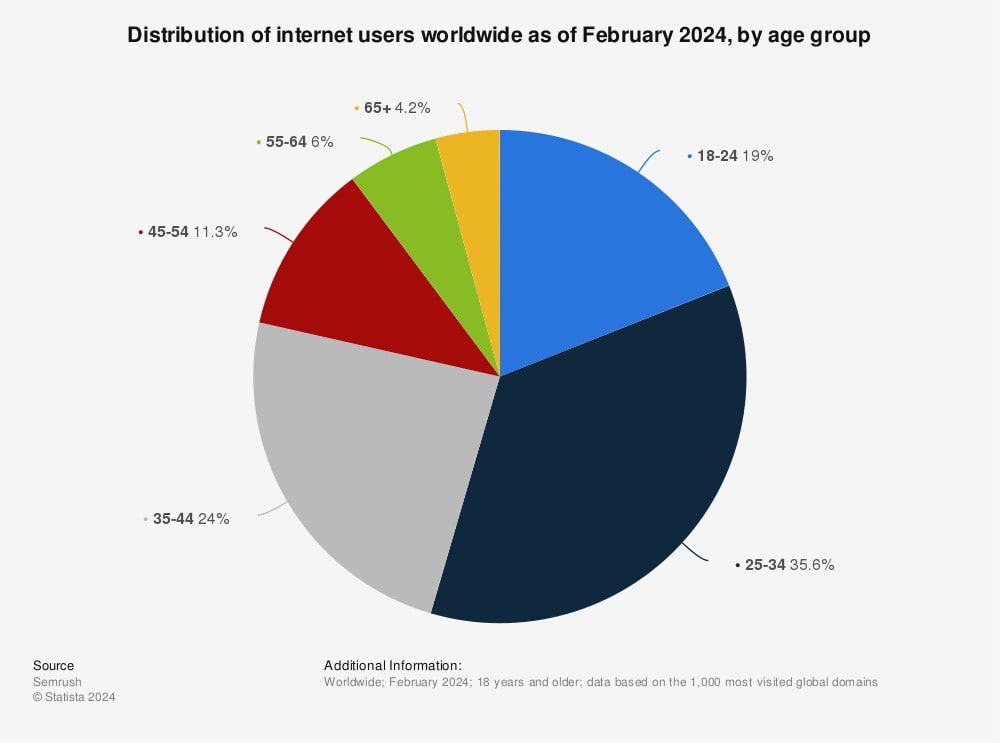
Below we have mentioned a table showcasing the percentage of internet usage globally based on Age group:
| Age Group | Percentage of Internet usage |
| 18 to 24 | 19% |
| 25 to 34 | 35.6% |
| 35 to 44 | 24% |
| 45 to 54 | 11.3% |
| 55 to 64 | 6% |
| 65 and above | 4.2% |
Source: Statista
Number of Internet and social media users worldwide
As of April 2024, the total number of Internet users was recorded to be 67.1% of the world population. About 5.44 billion users are Internet users and of this total, about 5.07 billion users access Social Media.
| Internet & Social Media | Number of users |
| Internet Users | 5.44 billion |
| Social Media Users | 5.07 billion |
Source: Statista
Share of Daily Internet Time Globally by Device
Over the years, there has been a significant increase in the percentage of users spending time on the internet on smartphones. Similarly, with the rise in users accessing mobile for internet usage, there has been a decrease in the usage of computers to access the internet on a daily basis.
During the fourth quarter of 2023, about 58% of the total daily time spent by internet users was through their mobile devices which includes smartphones and feature phones. While 42.2% of the time spent was through computers. The picture was quite different in 2017, where 54.4% of users utilized computers to access the internet, while the percentage of users utilizing mobile was 45.6%.
Below we have mentioned a table showcasing the share of daily internet time globally based on devices:
| Year | Mobiles | Computer |
| Q3 2017 | 45.6% | 54.4% |
| Q3 2018 | 49.5% | 50.5% |
| Q3 2019 | 50.8% | 49.2% |
| Q3 2020 | 52.8% | 47.2% |
| Q4 2020 | 52.2% | 47.8% |
| Q3 2021 | 53.5% | 46.5% |
| Q4 2021 | 54.7% | 45.3% |
| Q3 2022 | 56.9% | 43.1% |
| Q4 2022 | 57% | 43% |
| Q1 2023 | 56.8% | 43.2% |
| Q2 2023 | 57.1% | 42.9% |
| Q3 2023 | 57.6% | 42.4% |
| Q4 2023 | 57.8% | 42.2% |
Source: Statista
Number of Emails Exchanged by Internet Users
As of 2023, there were 347.3 billion emails exchanged by internet users per day and these numbers are expected to keep growing over the years. In 2024, the number of emails exchanged is projected to reach 361.6 billion. The figures are also expected to reach a milestone of 392.5 billion by 2026.
Below we have mentioned a table showcasing the number of emails exchanged by Internet users over the years:
| Year | Number of Emails Exchanged |
| 2026* | 392.5 billion |
| 2025* | 376.4 billion |
| 2024* | 361.6 billion |
| 2023 | 347.3 billion |
| 2022 | 333.2 billion |
| 2021 | 319.6 billion |
| 2020 | 306.4 billion |
| 2019 | 293.6 billion |
| 2018 | 281.1 billion |
| 2017 | 269 billion |
Source: Statista
Internet Usage Statistics in the U.S.
In this section, we are going to take a look at the internet usage statistics in the United States. We are going to highlight the total number of internet users, penetration rate, gender, and more.
Number of Internet Users in the US
As of 2024, the number of internet users in the United States was 323,56 million, and based on the latest reports the numbers are expected to witness excellent growth in upcoming years. The number of internet users in the U.S. is projected to reach 343.48 million in 2029.
Here is a breakdown of the number of internet users in the United States from 2020 to 2029:
| Year | Number of Internet Users In The US |
| 2029* | 343.48 million |
| 2028* | 340.46 million |
| 2027* | 336.6 million |
| 2026* | 332.51 million |
| 2025* | 328.16 million |
| 2024 | 323.56 million |
| 2023 | 318.66 million |
| 2022 | 313.6 million |
| 2021 | 308.6 million |
| 2020 | 301.78 million |
Internet users in the U.S. by gender
The percentage of internet users in the United States based on gender is pretty equal. In 2023, the share of male internet users was low in comparison to females. The latest data revealed 96% of females were accessing the internet in the United States, while the share for male users was 94%.
Here is a breakdown of internet users in the U.S. by gender:
| Year | Male | Female |
| 2023 | 94% | 96% |
| 2021 | 94% | 93% |
| 2019 | 90% | 91% |
| 2018 | 89% | 88% |
| 2016 | 89% | 86% |
| 2015 | 86% | 86% |
| 2014 | 84% | 84% |
| 2013 | 84% | 84% |
| 2012 | 83% | 82% |
Mobile Internet User Statistics
In this section, we are going to take an in-depth look at the statistics related to Mobile internet users.
Number of mobile internet users in the U.S.
As of 2023, the number of mobile internet users in the United States reached 295.46 million. With constant demand and need for the internet all across the world, the number of mobile internet users is expected to witness significant growth over the years. Number of mobile internet users is projected to reach a milestone of 333.18 million by 2029.
Here is a breakdown of the Number of mobile internet users in the United States:
| Year | Number of Mobile Internet Users |
| 2029* | 333.18 million |
| 2028* | 330.25 million |
| 2027* | 326.5 million |
| 2026* | 322.53 million |
| 2025* | 318.32 million |
| 2024* | 311.36 million |
| 2023 | 295.46 million |
| 2022 | 279.04 million |
| 2021 | 262.31 million |
| 2020 | 250.45 million |
Penetration Rate of mobile internet users in the U.S.
The Penetration rate of mobile internet users in the United States was 85.39% in 2023 and the numbers are projected to witness a significant growth over the years. The Penetration rate of mobile internet users is expected to reach 86.26% in 2024 and by 2029 the percentage is expected to reach a milestone of 89.2% in the United States.
Here is a breakdown of mobile internet users penetration rate in the United States:
| Year | Penetration Rate |
| 2029* | 89.2% |
| 2028* | 88.75% |
| 2027* | 88.24% |
| 2026* | 87.66% |
| 2025* | 87.01% |
| 2024* | 86.26% |
| 2023 | 85.39% |
| 2022 | 84.37% |
| 2021 | 83.15% |
| 2020 | 81.74% |
The smallest population to have internet access in the U.S. is Rural America
According to research by the Pew Research Centre, the rural areas of the United States have the smallest population to have access to the internet by 93%. The urban area in the U.S. has 95% of the internet access and the suburban area has 97% access to the internet across the U.S.
Social Media Statistics
The total number of internet users in 2024 is 5.44 billion out of which 5.04 billion social media users worldwide as of 2024. In 2023, the number of social media users was 4.90 billion, and in 2022 it was 4.59 billion.
Here is a breakdown of the number of social media users over the years:
| Year | Number of Social Media Users |
| 2024 | 5.04 billion |
| 2023 | 4.90 billion |
| 2022 | 4.59 billion |
| 2021 | 4.26 billion |
| 2020 | 3.9 billion |
| 2019 | 3.51 billion |
| 2018 | 3.1 billion |
| 2017 | 2.73 billion |
Active Internet users on different social media platforms
Out of 5.44 billion internet users worldwide, 5.07 billion internet users access Social media. Facebook is currently the most-used social media platform among internet users with 3.05 billion users. Followed by YouTube in the second position with 2.49 billion users and WhatsApp and Instagram in the third and fourth position with 2 billion users respectively.
Below we have mentioned a table listing down most-used social media platforms among internet users worldwide:
| Social Media Platform | Number of Users |
| 3.05 billion | |
| Youtube | 2.49 billion |
| 2 billion | |
| 2 billion | |
| TikTok | 1.56 billion |
| 1.34 billion | |
| Facebook Messenger | 979 million |
| Telegram | 800 million |
| Snapchat | 750 million |
How Internet Users Access Internet by Device
Mobile phones are the most popular device utilized by users to access the internet with 92.3%. Followed by laptops and desktops in the second position by 65.6%.
Below we have mentioned a table showcasing how internet users access the internet based on devices:
| Device | Share of Users |
| Mobile phone (any) | 92.3% |
| Laptop or desktop (any) | 65.6% |
| Smartphone | 91% |
| Feature phone | 5.2% |
| Tablet device | 27.3% |
| Own laptop or desktop | 59.1% |
| Work laptop or desktop | 28.6% |
| Connected television | 31.9% |
| Smart home device | 15.4% |
| Games console | 12.7% |
Most popular reasons for using the Internet worldwide
According to a report by Statista, finding information is the most popular reason (60.3%) behind users accessing the internet globally. Followed by connecting with family and friends as the second most popular reason behind users accessing the internet by 56.8%.
Below we have mentioned a table showcasing the top reasons behind users accessing the internet worldwide:
| Popular Reasons | Share of internet users |
| Finding Information | 60.3% |
| Staying in touch with friends and families | 56.8% |
| Watching videos, tv shows or movies | 52.3% |
| Keeping up to date with news and events | 50.8% |
| Researching how to do things | 48.5% |
| Finding new ideas and inspiration | 45.6% |
| Accessing and listening to music | 45.3% |
| Researching products and brands | 43.5% |
| Filling up spare time and browsing | 41.9% |
| Education and study-related purposes | 38.3% |
| Researching places, vacation and travel | 36.9% |
| Researching health issues and healthcare products | 35.2% |
| Managing finance and savings | 33.7% |
| Business-related research | 29.5% |
| Gaming | 29.3% |
Source: Statista
FAQs
How many people use the Internet in 2026?
6.3 billion people are using the internet in 2026 worldwide, which amounts to 76% of the world population.
Which country has the highest number of internet users?
China has the highest number of internet users worldwide with an estimated 1.05 billion internet users based on a report by Statista.
What is the internet used for most?
Finding information is the top characteristic by 60.3% for which the internet is used the most. Followed by staying in touch with friends and family as the second top reason at 56.8%, and watching online content as the third most popular reason behind users accessing the internet at 52.3%.
How many internet users are there in India?
The number of internet users in India is expected to reach 900 million by 2025 witnessing a rise of 141 million from the current 759 million users.
What happens in an internet minute in 2026?
Multiple things happen on the internet every minute in 2026. Millions of people check their emails, send out messages, perform online shopping, scroll through social media, watch videos, and much more. In addition, the time spent by users online on the internet is increasing every year with a 30% rise in online content consumption rate since the previous year.
Who uses the internet the most age?
The age group 25 to 34 uses the internet the most, with 35.6%, followed by the Age group 35 to 44, which has an internet usage rate of 24%.
Which country is no 1 in Internet speed?
Monaco is number one in internet speed with the leading broadband speed of 261.82 Mbps. Followed by Singapore in the second position with a broadband speed of 255.83 Mbps.
Wrapping Up
The above statistics highlight how the internet has become an essential part of everyday life, with approximately 6.3 billion people using it worldwide in 2026. People across the globe rely on the internet for social media, education, online shopping, banking, communication, and entertainment. However, around 2 billion people still remain offline, highlighting the gap in global internet access. Although internet adoption continues to grow, improving connectivity and affordability remains important to bring more people online.