
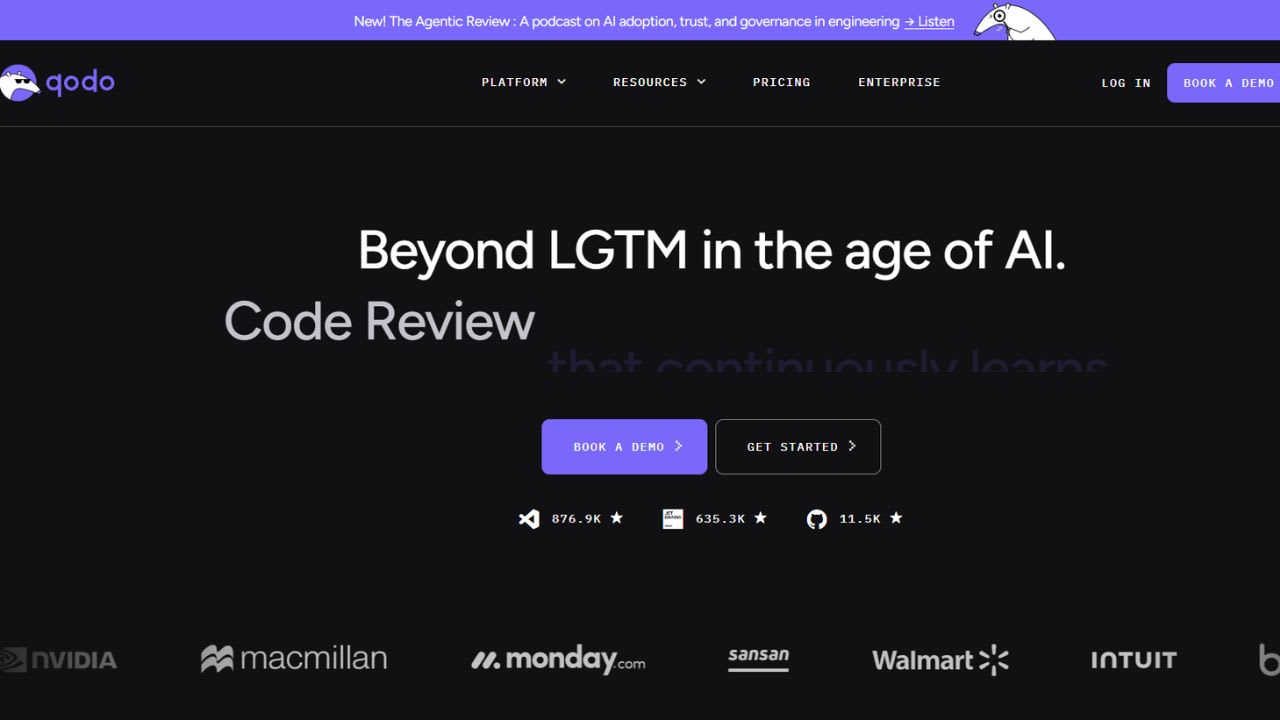
What is Qodo?
Qodo is a code review platform that checks pull requests, IDE diffs, and CLI changes for bugs, security gaps, and standards violations. The company started as CodiumAI in 2022 and rebranded to Qodo. It now positions itself as the review layer that sits next to coding copilots like Cursor and Copilot. Other tools generate code; Qodo focuses on confirming that the code you ship actually works.
The platform indexes whole codebases through a context engine that understands multi-repo codebases, allowing agents to detect issues that span components, services, and repositories. Review agents read each change against full repo history, dependencies, and prior PRs before flagging anything. This approach catches breaking changes across services that single-file scanners miss. Qodo ships 15+ automated pull request workflows out of the box, covering bug detection, missing tests, PR descriptions, changelog updates, and ticket compliance.
The tool learns from accepted suggestions and past reviewer comments, so feedback gets sharper over time. Teams set rules once, and Qodo enforces them everywhere. Qodo prevents 800+ potential issues monthly at monday.com while maintaining a 73.8% acceptance rate on code suggestions. The platform posts a 64.3% F1 score on the Code Review Bench and ranks #1 by Gartner for code in the Critical Capabilities for AI Assistants Report. A free Developer plan covers solo coders and open-source maintainers.
Top 5 Features of Qoda:
- Multi-repo context engine: Qodo indexes your entire codebase, not just the file you changed. The engine maps dependencies, shared modules, and cross-service patterns. Review agents then catch breaking changes, dependency conflicts, and architecture-level issues across multiple repositories, the kind of bugs single-diff scanners always miss. This works across Python, JavaScript, TypeScript, Java, C++, Go, Ruby, PHP, C#, and more with no configuration needed.
- 15+ agentic PR workflows: Each pull request triggers specialized agents that handle different jobs. Some flag bugs and security risks. Others trigger 15+ review agents in Git workflows to write pull request descriptions, flag issues with remediations, identify missing tests, and generate documentation. Severity tags tell you what blocks merging and what is just a nit, so you fix the critical issues first and ignore the noise.
- In-IDE pre-PR review: Qodo runs inside VS Code and JetBrains IDEs through plugins. Qodo’s agents analyze local diffs to identify logic errors, duplications, and missing tests, surfacing high-signal recommendations with precision and recall tuned to your organization’s rules and codebase. You catch problems at your desk before opening a pull request, which keeps reviewer queues clean.
- Custom rules and continuous learning: Teams define coding standards, security policies, and architecture patterns once through Qodo’s Rule System. The platform applies them to every PR. The system also reads past PR history, accepted comments, and rejected suggestions to refine what counts as “good code” for your team. Generic best-practice checks fill gaps when no team-specific rule applies.
- One-click remediation prompts: When Qodo flags an issue, it generates a ready-to-paste fix prompt with full context. Each issue also includes an agent-generated remediation prompt. Developers can copy this prompt directly into their preferred code generation or editing tool to fix the problem faster, with the full context preserved. This cuts the round-trip between finding a bug and merging the fix.
Verdict
Qodo earns its place as one of the more credible code review platforms on the market in 2026. The benchmark numbers, Gartner ranking, and customer logos like monday.com back the marketing claims. Multi-repo context is a real differentiator that diff-only competitors cannot match.
Who is this tool for: Engineering teams using AI coding assistants who want a separate quality layer that catches what copilots miss before code hits production.
Best For: Mid-size to enterprise teams managing multiple repositories, especially shops shipping high volumes of AI-written code where review noise and missed bugs slow delivery.
Weakness: The free Developer plan limits PR reviews: 30 per month per organization. This is a shared pool across the entire organization, not per user. Small teams blow through that cap quickly and must jump to the $30/user/month Teams plan, which scales fast for 5+ developers. G2 reviewers also flag Slow Performance, Testing Issues, Learning Curve and occasional false positives on complex PRs.
Qodo FAQs
Similar Tools like Qodo
Amazon Q Developer is a coding assistant from AWS. It can write code, fix bugs, and refactor code inside your …

Bolt AI is a browser-based app builder from StackBlitz that turns plain English prompts into working full-stac…

AI Code Converter is a versatile tool designed to transform natural language or existing code into the syntax …
CodeGeeX works as a free coding assistant for developers. Researchers at Tsinghua University built the tool, a…

Cody is a coding assistant from Sourcegraph that plugs directly into your IDE. It runs inside VS Code, JetBrai…

Bubble is revolutionizing the way we think about software development. It’s a no-code platform that empowers y…

Augment Code is a software agent company built for engineers who work on real production codebases. The platfo…

Tabnine is an AI-powered code completion assistant that aims to boost the efficiency and quality of software d…
Ready to try Qodo?
Discover what Qodo can do for you.
Try Qodo nowQodo reviews from real users
Verified visitor reviews — one per person, edits welcome.
Loading reviews…